When shopping for lift kits and truck accessories in Reading, begin by determining if you need a leveling solution or a complete suspension lift. A leveling upgrade corrects factory rake while maintaining daily handling, whereas a suspension lift offers clearance, wheel travel, and room for larger tires. You'll need exact year, trim, drivetrain, and suspension specifications to confirm Rough Country fitment. Budget for tires, alignment, and accessories such as steps, lights, or liners—you'll understand how the proper setup comes together
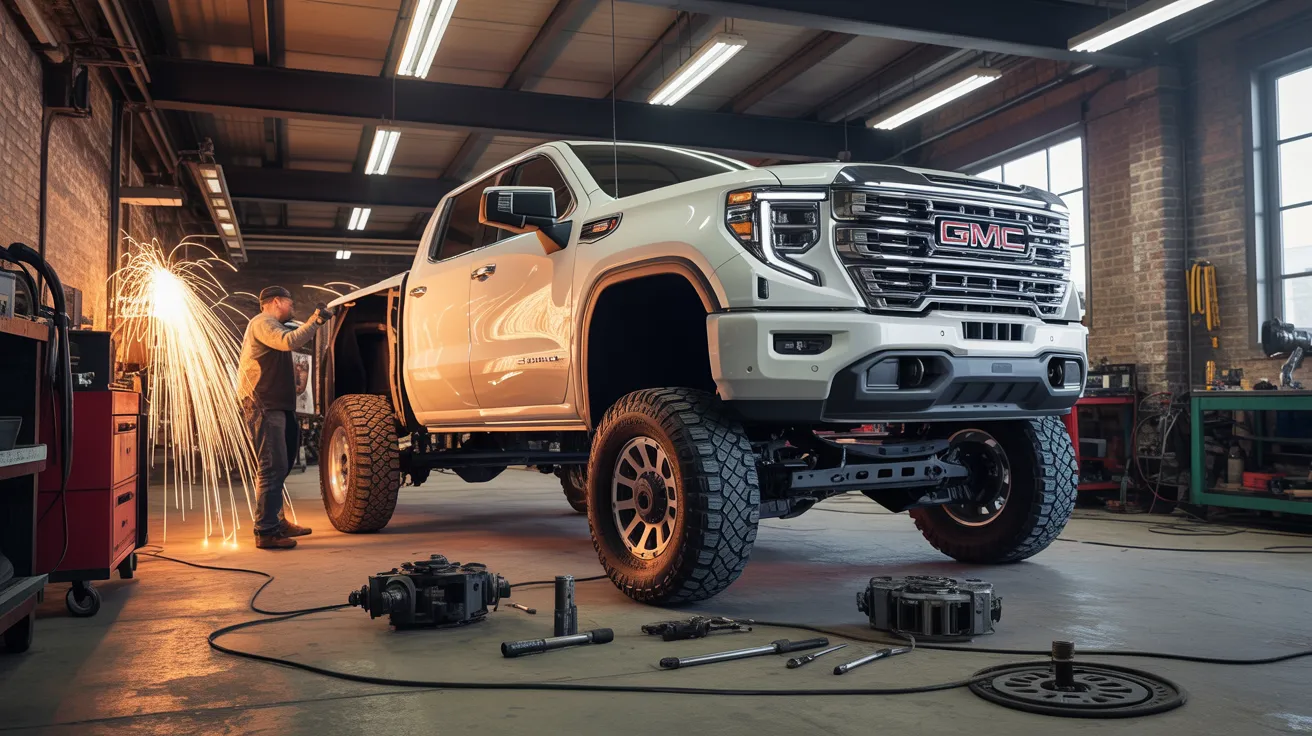
Important Highlights
- Choose a leveling kit to remove factory rake while keeping near-stock performance and fitting bigger tires for daily driving.
- Select a suspension lift to achieve more ground clearance, wheel travel, and off-road performance, understanding that handling and steering may adjust.
- Verify exact fitment using your truck's year, make, model, drivetrain, trim, cab, bed, and suspension package before ordering Rough Country parts.
- Match lift height and shocks to your application, whether commuting, mixed trail driving, towing, or heavier off-road travel.
- Budget for more than the kit price, including alignment, labor, wheels, tires, shocks, and add-on accessories like steps, lights, and liners.
Suspension Lifts versus Leveling Kits
Since both upgrades change your truck's appearance, suspension lift kits and leveling kits address distinct problems and offer different results. A leveling upgrade generally raises the front to correspond with the rear, correcting factory rake with minimal change to geometry, ride height, and daily drivability. You go with one when you desire a cleaner appearance and room for bigger tires.
A suspension lift kit raises the whole truck and changes critical parts to create more clearance and wheel travel. You'll notice bigger gains in ride height, off-road performance, and tire options, but you should expect handling tradeoffs, steering changes, and a higher center of gravity. If you want mild visual correction, level it. If you require real clearance and articulation, lift it and plan the supporting mods based on your use case.
Which Rough Country lift kit suits your truck?
Kick off by noting your truck's year, make, and model, drivetrain, and intended application, as Rough Country manufactures lift kits for exact structural design and capability targets. This baseline reveals which mounting hardware and suspension pieces will mount properly without clearance or alignment issues.
Start by examining factory ride height, cab layout and cargo bed configuration, axle configuration, and whether your truck features 2WD, 4WD, or adaptive suspension. Rough Country compatibility guides help with this step, but you still need to confirm fitment accuracy against trim-level parts and OEM package variations. A kit designed for a Silverado 1500 may not fit a Trail Boss, and a Ram equipped with air-based suspension needs different adjustments versus a truck with coil springs. By confirming exact fitment upfront, you sidestep installation issues, compatibility issues, and return hassles.
What Rough Country lift kit suits your driving habits?
Pair the kit to your driving patterns, and you'll get improved ride comfort, reliability, and tire space without purchasing unnecessary capability. If you mainly commute in your truck, select a basic Rough resource Country leveling kit or a 2 to 3.5 inch suspension setup calibrated for daily comfort and stable steering response.
If your truck sees both pavement and trail time, move up to a suspension lift featuring premium shocks and optimized control arm positioning. You'll enjoy improved trail handling, superior articulation, and clearance for larger tires without overloading original components. For heavier trail use, emphasize lifted struts, N3 or Vertex shock dampers, and setups that keep driveline angles correct under compression. The ideal Rough Country setup needs to match payload, speed, and terrain, and your preferred ride firmness.
Leading Rough Country Truck Accessories
Round out your suspension upgrade with Rough Country aftermarket items that solve the real weak points you'll notice after changing ride height, tire size, and vehicle stance. Focus on upgraded steps or rock guards, which recover vehicle access and add lower-vehicle protection when your truck sits higher and wider.
Then prioritize visibility and control. Rough Country light systems extend usable sightlines on night trails, work sites, and country roads without difficult installation. Seat covers and floor liners safeguard the interior from mud, gravel, and water you'll drag in after trail use. Fender extensions manage tire throw and accent the broader stance provided by larger rubber. For towing or pulling, reinforced hitches, towing accessories, and winch-mounted bumpers provide function without impacting compatibility. Choose items that match your truck's new geometry and load capacity.
What Budget Should You Plan for Your Build?
After you've chosen the lift kit and auxiliary components, establish a budget surpassing the listed kit price. You'll require money for suspension shocks, wheel rims, tire set, wheel alignment, labor, and any drivetrain or steering upgrades your vehicle requires. Company reputation plays a role here; luxury kits tend to deliver tighter tolerances, better ride quality, and fewer install headaches.
Regarding realistic cost projections, expect entry-level spacer or leveling setups to start at lower prices, while comprehensive suspension packages with control arms, tuned dampers, and bigger tires increase fast. Installation complexity, labor costs, and calibration work may contribute significantly. You should also price additional upgrades such as gear swaps, brake parts, and recovery tools if you intend for off-road use. If cash flow matters, assess financing options carefully and prioritize reliability rather than fancy extras.
Common Questions Answered
Do Lift Kits Impact Factory Warranty?
Yes, lift kits can affect your factory warranty coverage, but they won't automatically cancel it. You face warranty issues should the manufacturer demonstrates the lift kit caused or contributed to a failure. Powertrain, steering, suspension, and drivetrain claims frequently create dealer conflicts. You need to preserve install paperwork, use premium parts, and follow service intervals. This enables you to refute denied claims and safeguard warranty when the modification isn't responsible.
Do Bigger Tires Mean Re-Gearing?
Yes—if you jump multiple tire sizes, you'll usually require re-gearing. Consider moving from 31s to 35s, for example—your vehicle can feel sluggish, shift irregularly, and build drivetrain stress under load. Gear ratio changes bring back effective gear ratios, allowing you to recover acceleration, towing efficiency, and transmission operation. You might not need it for small tire upgrades, however if power, fuel economy, or shift quality drop, it's typically the right decision.
When Should You Check Your Lift Kit?
You need to examine lift kit components after the first 500 miles, then at every oil change or 3,000 to 5,000 miles, depending on use. Periodic inspections enable you to spot wear on bushings, shock fluid leaks, damaged brackets, and alignment concerns early. Verify fastener tightness post-aggressive terrain driving, cargo hauling, or hard impacts. If you drive in mud, salt, or rough terrain often, tighten inspection schedules and examine suspension and steering parts at faster intervals.
Will a lift kit affect towing or payload capacity?
Yes, a suspension kit can impact your truck's towing and payload ratings. When you increase ground clearance for additional clearance, you change suspension geometry, center of gravity, and leverage on components. That can reduce stability under load and boost drivetrain stress, particularly with oversized tires. You should follow your manufacturer's ratings unless an professionally designed kit specifically documents updated ratings. Proper alignment, gear ratios, and brake performance are important as well.
Is alignment work necessary after you install truck accessories?
Yes—if accessories change ground height, suspension design, steering angles, or tire dimensions, you need an alignment. You'll feel the theory fast: minor adjustments can cause your truck to pull to one side, wear tread quickly, and reduce handling quality. A proper wheel alignment returns camber, caster angle, and toe angle to spec. After specific installations, you might require brake calibration for driver assistance precision. You preserve tire longevity, steering accuracy, and real-world safety by checking alignment immediately.
Final Thoughts
Selecting the right suspension setup and accessories depends on how you use your truck, your preferred appearance, and what your budget can handle. When you match a Rough Country suspension to your driving habits, you'll get performance, clearance, and looks which complement each other like a well-tuned drivetrain. Include smart accessories, budget wisely, and you'll build a vehicle that's dependable for daily driving, strong off-road, and ready for whatever job comes next.